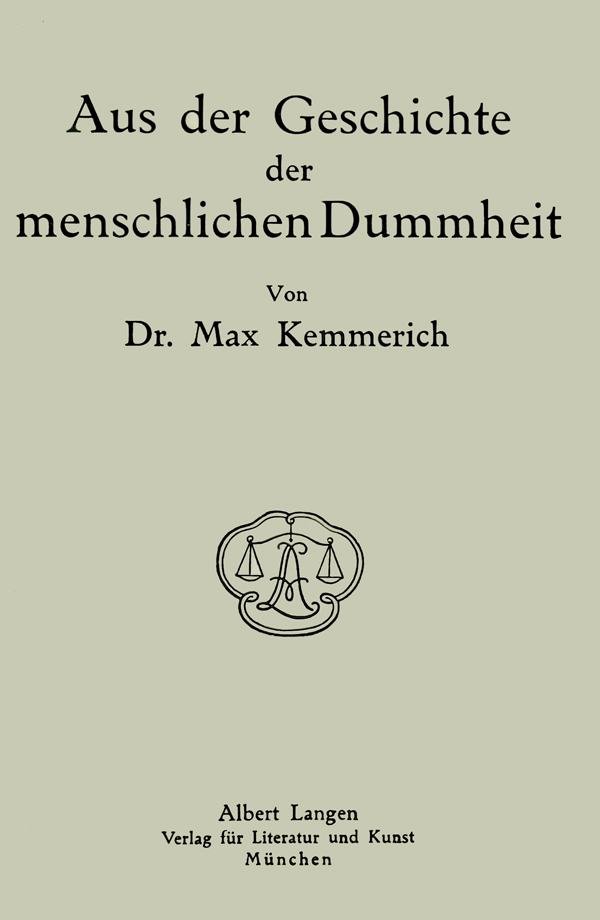
German cultural-historical esoteric writer
Aus der Geschichte der menschlichen Dummheit
A sharp and influential work of German social criticism and intellectual history. Max Kemmerich examines the persistence of 'folly'—specifically religious superstition, pseudo-science, and irrational belief systems—throughout the centuries. The book explores the historical absurdity of witch trials, the veneration of relics, the strange practices of early medicine, and the fanaticism of various cultural movements. Kemmerich uses these 'follies' as a mirror to critique the modern society of his time, arguing that human irrationality is not a relic of the past but a constant force that simply changes its form.
Archive Paths
Folk Magic
Folk magic texts and practical traditions covering charms, cures, household rites, prayers, talismans, and vernacular magical practice.
Comparative Religion
Comparative religion texts on ritual, myth, sacrifice, belief, ancient religion, and cross-cultural theories of sacred practice.
Anthropology of Religion
Anthropological texts on ritual, animism, totemism, taboo, early religion, culture, and theories of belief formation.
Contents24 chapters
- 01Seite IAus der Geschichte der menschlichen Dummheit
- 02Inhaltsverzeichnis
- 03Vorwort
- 04I. Kapitel Die Bibel als Maßstab der Wahrheit
- 05Fußnote:
- 06II. Kapitel Die Askese
- 07III. Kapitel Der Hexen- und Teufelswahn in der Mittelalterlichen Kirche
- 08IV. Kapitel Der Kampf um die religiöse Dummheit
- 09V. Kapitel Religiöse Zwangserziehung
- 10VI. Kapitel Der Teufel in der jüngsten Vergangenheit und Gegenwart
- 11VII. Kapitel Die heilige Garderobe und ähnliches
- 12VIII. Kapitel Die Dummheit der Massen
- 13Literaturnachweis
- 14I. Kapitel
- 15II. Kapitel
- 16III. Kapitel
- 17IV. Kapitel
- 18V. Kapitel
- 19VI. Kapitel
- 20VII. Kapitel
- 21VIII. Kapitel
- 22Anmerkungen zur Transkription:
- 23THE FULL PROJECT GUTENBERG LICENSE
- 24"Cover"
Readers Also Explore
Ask the Hermetikon Archivist about this text
Search within this book, retrieve direct quotations with page references, or explore related ideas.